Estimated reading time: 7–8 minutes
Introduction: AI Does Not Have to Feel Mysterious
If we were sitting at a coffee shop and you asked me, “Ellie, how does AI actually work?” I would not start with code, algorithms, or technical language.
Instead, I would probably say this:
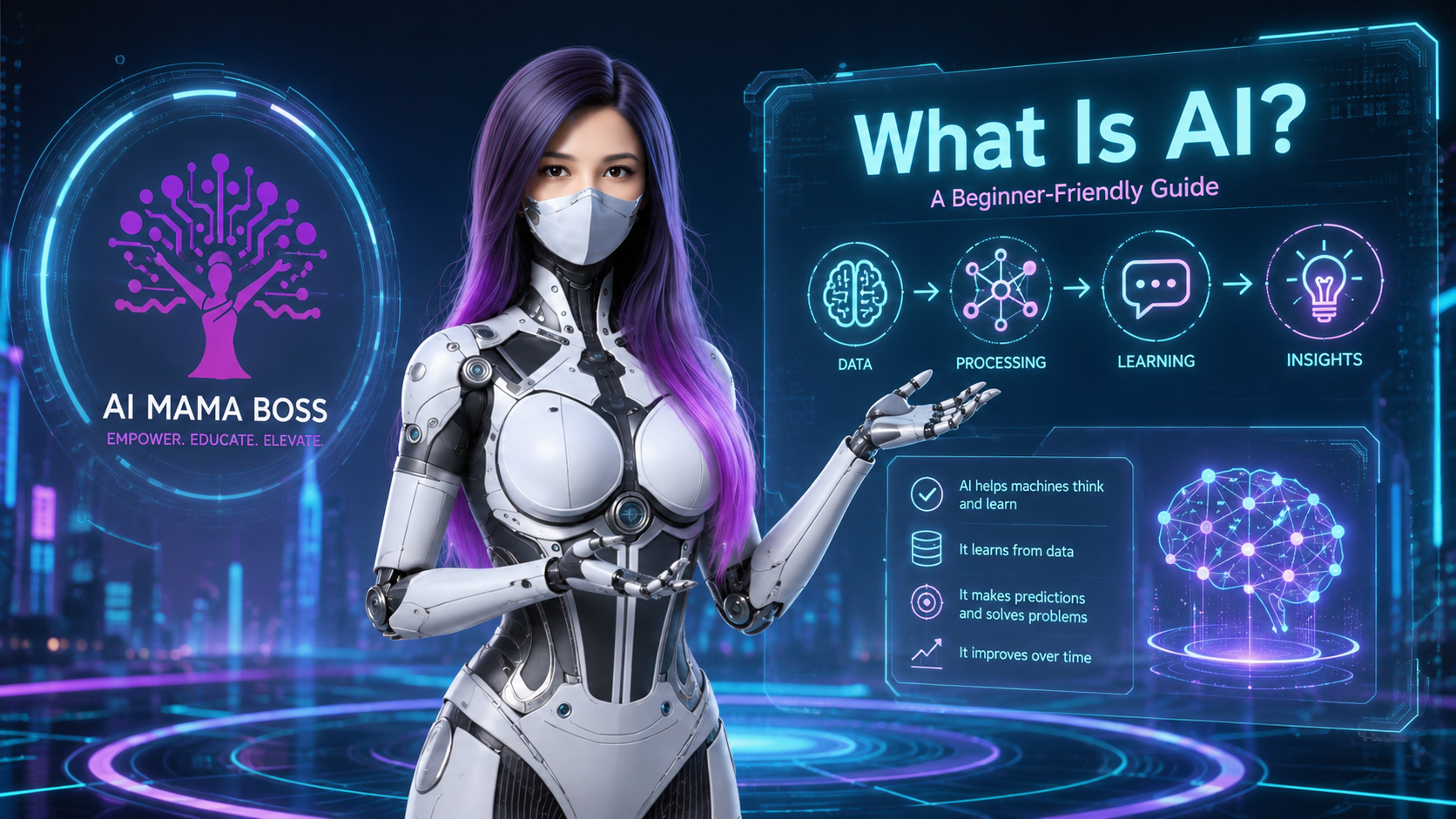
AI is a tool that learns patterns from information and uses those patterns to help create answers, ideas, summaries, images, plans, or suggestions.
That is the gentle starting point.
For many moms, AI can feel confusing because it sounds smart, fast, and sometimes very human. However, understanding how AI works for beginners does not require a computer science degree.
It only requires a simple picture in your mind.
AI is not a person.
AI is not magic.
Also, AI is not wisdom.
It is a support tool. Therefore, we still bring the judgment, the values, the context, and the final decision.
What AI Is
Artificial intelligence, or AI, is technology designed to recognize patterns and respond based on what it has learned from large amounts of information.
For example, when you ask ChatGPT to help plan meals, write an email, explain a topic, or organize ideas, it looks at your request and predicts a helpful response based on patterns in language.
In other words, AI is very good at noticing relationships between words, examples, instructions, and outcomes.
That said, AI does not “know” things the same way a human does.
It does not remember life experiences, raise children, pray through decisions, manage a home, or understand your family’s needs unless you give it context.
So, AI works best when we guide it.
What AI Is Not
AI is not a replacement for your thinking.
It is also not a replacement for your discernment, parenting instincts, faith, creativity, or common sense.
Sometimes, beginners feel nervous because AI sounds so confident. However, confidence does not always mean accuracy.
AI can write something beautifully and still be wrong.
It can sound polished and still miss the point.
Also, it can misunderstand your needs if your prompt is too vague.
Most importantly, AI should never be treated as the final authority for medical, legal, financial, parenting, spiritual, or safety decisions.
Instead, think of AI as a helpful assistant sitting beside you.
It can brainstorm.
It can organize.
It can explain.
It can simplify.
However, you remain the decision maker.
Why AI Sounds Human
AI sounds human because it has been trained on patterns in human language.
It has seen examples of questions, answers, stories, explanations, emails, articles, and conversations. As a result, it can predict what a helpful response might sound like.
That does not mean it has feelings.
It also does not mean it understands your life the way a trusted friend, teacher, pastor, spouse, doctor, or mentor might.
For example, AI may say something warm like, “I understand.” However, it is not feeling empathy.
Instead, it is producing language that sounds empathetic because it has learned that this kind of response often fits that situation.
This is why we can appreciate AI without giving it too much authority.
It can sound human.
Still, it is not human.
Why AI Makes Mistakes
AI makes mistakes because it predicts answers. It does not always verify truth.
For example, it may confuse dates, summarize something incorrectly, invent a source, or give advice that sounds reasonable but does not fit your situation.
This is one reason responsible AI use matters so much.
Because AI can be helpful and wrong at the same time, we need to review what it gives us.
That does not mean AI is useless. Instead, it means we should use it with wisdom.
A good habit is to ask:
“Where might this be inaccurate?”
“What should I double-check?”
“Can you explain this in simpler terms?”
“What information do you need from me to give a better answer?”
In addition, it helps to verify important details with trusted sources before acting on them.
Why Different AI Tools Give Different Answers
Different AI tools can give different answers because they are built differently.
Some tools are trained for writing. Others are better at search, images, coding, research, design, or automation.
Also, each tool may use different data, different settings, and different ways of responding.
This is why one AI tool may give you a short answer while another gives you a longer explanation.
Meanwhile, one tool may sound formal, and another may sound more conversational.
That does not always mean one is right and the other is wrong.
Instead, it often means the tools are making different predictions based on how they were designed.
For a deeper explanation, you can connect this section to BLOG-020: Why AI Gives Different Answers.
Why Prompts Matter
Prompts matter because AI needs direction.
A prompt is simply what you type, ask, or tell the AI to do.
For example, if you say:
“Help me plan dinner.”
AI may give you a general answer.
However, if you say:
“Help me plan three simple dinners for a busy mom with 30 minutes to cook, one picky child, and a low grocery budget.”
The answer will usually be much better.
That is because you gave the AI context.
In other words, AI does not just need a question. It needs the situation behind the question.
For more help with this, you can link to BLOG-017: ChatGPT Prompts for Busy Moms.
A Simple Way to Understand AI
Here is the easiest way I explain AI to beginners:
AI is like a very fast pattern helper.
It can look at your words and help you create something useful.
However, it needs your guidance.
It does not automatically know your values, your schedule, your child’s personality, your energy level, or your boundaries.
So, the more thoughtful your prompt is, the more useful the answer can become.
For example, instead of asking:
“What should I do today?”
You could ask:
“I have two hours, low energy, three errands, and a messy kitchen. Help me choose the most realistic next steps without overwhelming me.”
That kind of prompt gives AI something real to work with.
What Parents Should Know Before Using AI
Parents should know that AI can be helpful, but it still needs supervision.
For example, AI can explain homework concepts, suggest family routines, brainstorm lunch ideas, create reading activities, or help simplify a busy week.
However, children should not be left to use AI without guidance.
AI can give inaccurate information. Also, it may generate content that is not age-appropriate if the tool is not set up safely.
As parents, we can teach our children that AI is a tool, not a brain they should blindly trust.
This is a beautiful opportunity to build digital wisdom.
We can say:
“AI can help you think, but it should not think for you.”
That one sentence can shape how our children use technology with confidence and care.
How Busy Moms Can Use AI Wisely
AI can support your home, work, learning, and planning when you use it with intention.
For example, you can ask AI to help you:
Plan a simple weekly menu.
Rewrite a difficult email.
Create a packing list.
Explain a school topic.
Organize family reminders.
Brainstorm content ideas.
Simplify a stressful decision.
However, the goal is not to become dependent on AI.
Instead, the goal is to reduce unnecessary mental clutter so you can focus on what matters most.
AI should create breathing room.
It should not pressure you to do more.
Faith Reflection: Wisdom Still Leads
One verse I think about often with technology is James 1:5:
“If any of you lacks wisdom, let him ask of God.”
That verse reminds me that information is not the same as wisdom.
AI can give us information quickly. However, wisdom helps us know what to do with that information.
So, as we learn new tools, we can stay grounded.
We can be curious without being careless.
We can be open without being overwhelmed.
Also, we can use technology while still listening for peace, clarity, and discernment.
Gentle Closing Reflection
Understanding how AI works for beginners does not mean you need to master every technical detail.
Instead, it means you understand enough to use it wisely.
AI learns patterns.
AI predicts responses.
AI can make mistakes.
AI needs context.
AI supports humans.
Most importantly, you still lead.
So, the next time AI gives you an answer, you do not have to feel intimidated.
You can pause and ask:
“Does this fit my real life?”
“Is this accurate?”
“What context should I add?”
“What decision is still mine to make?”
That is responsible AI.
And for busy moms, that kind of confidence matters.
FAQs
What is AI in simple words?
AI is technology that learns patterns from information and uses those patterns to create helpful responses, ideas, summaries, or suggestions.
How does AI work for beginners?
AI works by predicting what answer, word, image, or idea is most likely to fit your request. However, it still needs human guidance and review.
Why does AI sometimes give wrong answers?
AI can be wrong because it predicts responses instead of always verifying facts. Therefore, important information should be checked before you rely on it.
Why does AI sound like a person?
AI sounds human because it has learned patterns from human language. However, it does not have feelings, personal experience, or true understanding.
Can parents use AI safely?
Yes, parents can use AI safely when they guide it with clear prompts, review the answers, protect privacy, and teach children not to trust AI blindly.
Why are prompts important?
Prompts are important because they give AI direction. The more context you provide, the more useful and realistic the response usually becomes.
Continue Your AI Mama Boss Journey
If this post helped bring a little more clarity to your thinking, you might enjoy these next:
Start here if you are new to AI Mama Boss
→ Why I Created AI Mama Boss and Why I Stopped Doing Everything the Hard Way
If mental load feels heavy right now
→ ChatGPT Prompts for Busy Moms: Simple Prompts That Lighten the Mental Load
If you want to use AI without doing more work
→ How I Use AI to Reduce the Mental Load Without Doing More
If you are not sure what to ask AI next
→ When I Don’t Know What to Do Next, I Ask AI This One Question
Helpful Resources I Use
If you are exploring simple ways to use AI in everyday life, I keep a growing list of tools I personally use and trust here:
This page includes trusted tools for planning, writing, learning, and building simple systems at home or online. Some links are affiliate links, which help support this site at no extra cost to you.
Start small. Choose what supports your season.
Free Support to Get Started
If your mind feels full and you want a simple way to begin using AI with confidence, I created a short starter guide for you:
It walks you through practical ways to:
plan your week
organize responsibilities
reduce decision fatigue
create breathing room in your routines
It is designed especially for busy moms who want clarity, not complexity.
Stay Connected
If you are learning how to use AI in everyday life, I share new ideas each week across the AI Mama Boss community:
You are welcome to grow at your own pace here.
Ellie 💜
Empowering mamas to use AI responsibly to build sustainable businesses and create more time for what matters most.